

By Dr. Moneera Otoom Commentary Prof. Khalil alsalem
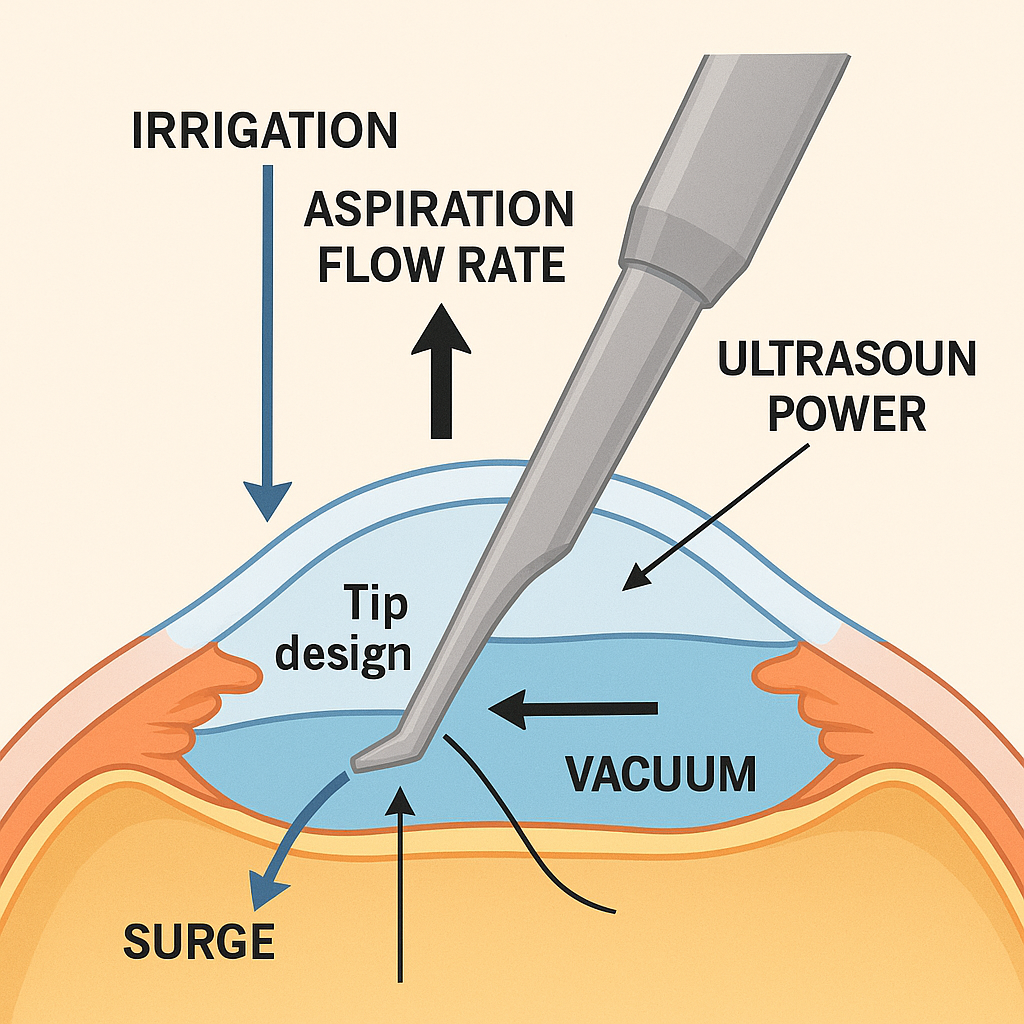
The evolution of cataract surgery into a fluidics-driven, micro-incisional procedure has made a detailed understanding of phaco dynamics essential for every cataract specialist. While machines have become increasingly automated, real surgical safety still depends on the surgeon’s mastery of how ultrasound energy, aspiration, vacuum, and irrigation interact inside the anterior chamber. Subtle changes in these parameters can dramatically alter efficiency, chatter, chamber stability, and the risk profile of each step of surgery. The following framework summarizes the fundamental principles of phaco dynamics and their application in modern cataract surgery.
1. Ultrasound Power Delivery: Modes and Tissue Interaction
Ultrasound (US) energy is the primary cutting force in conventional phacoemulsification. Its behavior in the anterior chamber depends on the mode of delivery, frequency, and stroke length.
a. Longitudinal Ultrasound
This is the classic forward–backward motion.
Advantages: high cutting efficiency for dense nuclei.
Drawback: “repulsion” or “chatter,” pushing fragments away from the tip.
Repulsion increases with higher power settings and longer stroke length.
b. Torsional Ultrasound
Rotational shearing motion introduced to reduce repulsion.
Increases followability by minimizing tip chatter.
Produces smoother emulsification with reduced endothelial energy exposure.
c. Transverse and Elliptical Ultrasound
Elliptical blending offers both shearing and axial movement, improving cutting efficiency and reducing clogging.
d. Pulse and Burst Modulation
Pulsed delivery limits continuous thermal load and reduces chatter. Burst modes allow controlled energy release dependent on tip occlusion.
Clinical implication:
Modulating ultrasound power—rather than simply increasing amplitude—reduces endothelial insult and enhances fragment followability, especially in soft to moderate nuclei.
2. Aspiration Flow Rate: The Driver of Followability and Tip Attraction
Aspiration flow rate (AFR) determines how quickly fluid—and nuclear material—moves toward the phaco tip.
Higher flow rate → stronger fluid drag → improved followability.
Lower flow rate → safer for shallow anterior chambers or weak zonules.
Flow rate primarily determines the speed of fragment engagement, not the holding force (vacuum handles that). However, excessive AFR can destabilize the chamber, increase surge risk, and stress the posterior capsule during post-occlusion events.
In high-vacuum techniques (e.g., phaco chop), AFR must be carefully matched with vacuum level to maintain stable attraction without chamber collapse.
3. Vacuum: The Holding Force for Fragment Manipulation
Vacuum is responsible for holdability, the surgeon’s ability to anchor a nuclear fragment onto the tip.
Higher vacuum → strong grip for chopping techniques.
Lower vacuum → safer but less efficient, used in divide-and-conquer or grooving.
Vacuum only rises when the tip is occluded. A stable occlusion is essential for efficient chopping, especially in posterior plate disassembly.
Chamber Implications
Once occlusion breaks, the sudden release of vacuum triggers surge, causing rapid fluid outflow and potential posterior capsule rebound. Surge management is a cornerstone of safe phaco dynamics.
4. Irrigation: Maintaining Chamber Stability
Irrigation pressure—determined by bottle height or active fluidics—maintains anterior chamber depth. Cataract specialists must visualize fluidics as a three-way balance:
Irrigation IN = Aspiration OUT + Leakage around incisions
If irrigation cannot compensate for aspiration, the chamber shallows, risking:
corneal endothelium contact, iris prolapse, posterior capsule billowing
Active Fluidics Systems
Modern phaco machines (e.g., Centurion’s Active Fluidics) adjust irrigation pressure dynamically to counter fluctuations in aspiration and vacuum. This significantly reduces surge and stabilizes the chamber, even in micro-incisional surgery.
5. Surge and Post-Occlusion Behavior: The Critical Safety Zone
Surge occurs when the tip loses occlusion while under high vacuum, causing a sudden drop in chamber pressure.
Strategies to reduce surge:
Lower aspiration flow rate
Higher irrigation pressure or active fluidics
Use of small-bore or tapered tips
Occlusion sensing algorithms
Torsional/elliptical modes (less repulsion → fewer occlusion breaks)
Understanding each machine’s surge characteristics enables surgeons to customize settings for dense cataracts, floppy iris syndrome, shallow chambers, or capsule instability.
6. Tip Design and Sleeve Dynamics
Phaco efficiency and chamber behavior are strongly influenced by:
Tip bevel angle, Aperture size, Inflation of the silicone sleeve, Port size and geometry
A 45–60° bevel improves followability and chopping interface. Micro-incision surgery requires optimized sleeve design to maintain irrigation despite smaller side-port openings.
7. Energy Efficiency and Endothelial Protection
Phaco dynamics ultimately determine endothelial preservation. Key principles include:
Use torsional/elliptical modes to reduce repulsion.
Apply high vacuum with controlled flow to minimize US exposure time.
Maintain stable chamber pressure to reduce corneal edema and Descemet folds.
Use OCT-based energy metrics to monitor cumulative dissipated energy (CDE).
Conclusion
Phaco dynamics is the true engine behind safe, efficient cataract surgery. Mastery requires understanding how ultrasound energy, vacuum, aspiration, and irrigation interact in real time. As systems evolve toward intelligent fluidics, the surgeon’s role in selecting appropriate settings for each eye becomes even more critical. For cataract specialists, dynamic control—not simply technology—is the key to chamber stability, efficient nuclear removal, and long-term corneal clarity.