

Written by Prof. Khalil Alsalem
Cosmetic Dermatology laser use has expanded rapidly in cosmetic and medical practice—hair removal, tattoo removal, skin resurfacing, vascular lesions, pigmentary disorders. With that expansion has come a steady trickle of serious ocular injuries, including visually devastating retinal burns. For ophthalmologists, these cases may present “out of the blue” after a routine cosmetic procedure performed outside the hospital. Understanding the typical mechanisms and patterns of injury is essential for diagnosis, prognosis and, importantly, for counseling colleagues about prevention. Here in, we discuss the some of the unfortunate cases of retinal Burns from dermatology lasers, and how macular burns can vary in patterns and clinical presentation.
Lasers, wavelengths and how they reach the retina
Most dermatologic systems used on the face are Class 3B or 4 lasers, including Q-switched Nd:YAG (532/1064 nm), alexandrite (755 nm), diode (800–810 nm), and Er:YAG or CO₂ for resurfacing. Longer wavelengths in the near-infrared and red region penetrate more deeply, and for many devices the ocular media are relatively transparent, allowing radiant energy to reach the posterior pole
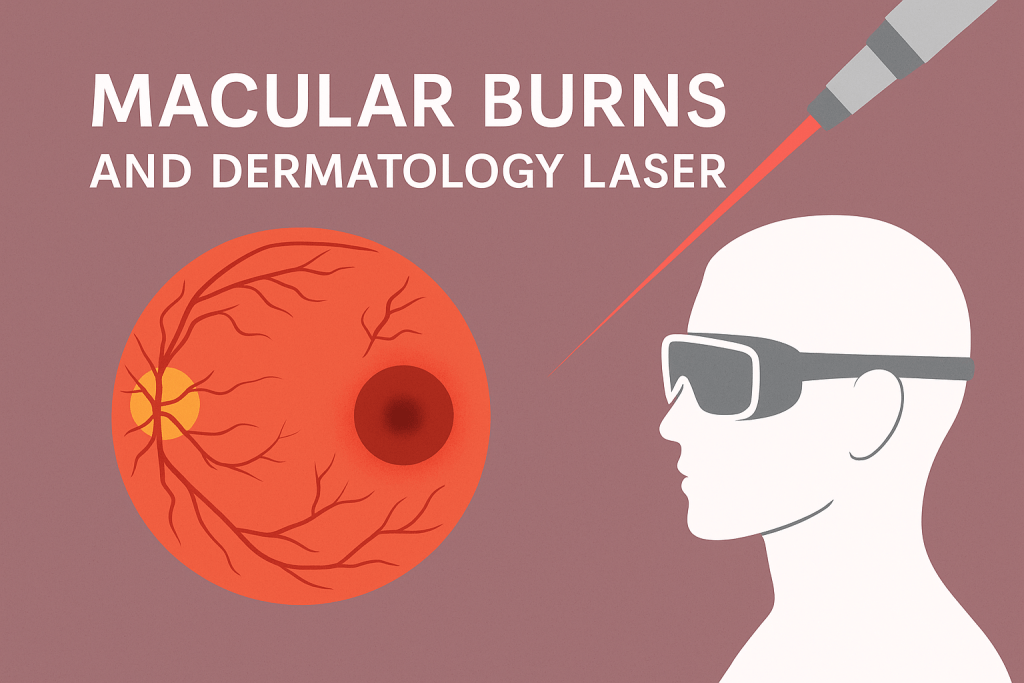
Retinal Burns from Dermatology Lasers is typically photothermal. Short, high-fluence pulses focused by the eye’s optics can exceed the retinal damage threshold by orders of magnitude, producing immediate photoreceptor and RPE disruption, intraretinal hemorrhage, and—in severe cases—full-thickness chorioretinal scars. Q-switched systems, in particular, can deliver very high peak powers in nanoseconds, with macular burns resembling those from military or industrial lasers.
Clinical patterns: from macular burns to delayed CNV
Recent case reports highlight the variety of presentations. A 29-year-old woman sustained a macular burn from a handheld Q-switched Nd:YAG device used for skin resurfacing at a spa; no eye protection was provided. She developed an immediate dense central scotoma with irreversible loss of visual acuity due to a foveal chorioretinal scar. Another report described a 24-year-old technician exposed during laser hair removal; she later developed choroidal neovascularization at the fovea requiring intravitreal therapy.
Epilation of periorbital hair is particularly dangerous. When treating eyebrows or upper cheeks, the laser is often directed towards the orbit; even a brief removal of goggles “just to get closer to the lash line” has resulted in bilateral macular burns. A 2018 series on cosmetic facial lasers noted that ocular injuries included corneal burns, iritis, and retinal damage, with a strong association between periorbital treatment and posterior segment injury.
Importantly, not all cases present with immediate profound central vision loss. Peripheral retinal burns from off-axis exposure can initially spare acuity, but subsequent vitreomacular traction, macular edema, or secondary CNV may cause delayed vision decline, underscoring the need for ongoing follow-up.
Symptoms, signs and imaging Retinal Burns from Dermatology Lasers
Patients typically report an acute flash of light during the procedure, followed within minutes to hours by blurred vision, central or paracentral scotoma, metamorphopsia, or new floaters. Associated symptoms may include photophobia, eye pain, or headache.
On examination, findings range from subtle foveal granularity and small intraretinal hemorrhages to frank yellow-white chorioretinal lesions with overlying edema or hemorrhage. OCT often shows ellipsoid zone loss, RPE disruption, outer retinal cavitation, or full-thickness disorganization; OCT-A can reveal choriocapillaris dropout or CNV. Fluorescein and ICG angiography may demonstrate early hyperfluorescence, late staining, or leakage if neovascularization develops.
How often is protection missing?
Across case series and reviews of cosmetic laser–related ocular injuries, the majority of patients were either not wearing eye protection or had protection removed briefly to treat areas close to the eyelids. One analysis of facial aesthetic laser injuries reported that in more than 60% of cases, protective eyewear was absent or removed during treatment. Even when shields were used, accidents still occurred if the wrong wavelength filter was chosen or if scattered/reflected beams were underestimated.
Standards and the critical role of wavelength-matched goggles
The American National Standard ANSI Z136.3 (“Safe Use of Lasers in Health Care”) and related laser safety guidelines are explicit: whenever Class 3B or 4 medical lasers are in use, all persons in the nominal hazard zone must wear laser-protective eyewear matched to the wavelength and optical density (OD) of the device, unless the beam is fully enclosed.The ANSI Blog+2ASLMS+2 The eyewear must be clearly labeled with its wavelength range and OD, and different goggles may be required for different systems (e.g., 755 nm alexandrite vs 1064 nm Nd:YAG).
For periorbital treatments, the gold standard is to combine external wavelength-specific goggles for staff with properly inserted metal intraocular corneal shields for the patient when treating eyelids or very close periocular skin. Even scattered or reflected laser energy can exceed the maximum permissible exposure for the retina, especially with high-fluence, long-pulse devices.MDPI+1
What ophthalmologists should do for Retinal Burns from Dermatology Lasers
When confronted with suspected dermatologic laser injury, ophthalmologists should:
Obtain a detailed history: laser type if known, indication (hair removal, resurfacing, pigment), treatment location (eyelids, brow, cheek), use and type of eye protection, and timing of symptoms.
Perform careful macular and peripheral examination, OCT (± OCT-A), and angiography if indicated.
Counsel patients about the prognosis: central foveal burns often leave permanent scotomas; peripheral burns may still lead to delayed macular complications.
Report the incident back to the treating dermatologist, spa, or clinic, emphasizing the likely mechanism and the failure or absence of appropriate eye protection.
Encourage dermatology colleagues to adopt formal laser safety programs aligned with ANSI Z136.3, including mandatory goggles, intraocular shields for periocular work, non-reflective room surfaces, and documented staff training.
Retinal burns from dermatologic lasers are entirely preventable tragedies. For ophthalmologists, each case is not only a diagnostic challenge but also an opportunity: to educate our patients, to elevate safety standards in neighboring specialties, and to insist that high-energy light in the cosmetic setting be treated with the same respect we demand in the operating theatre.

Retinal Burns from Dermatology Lasers ( Endolift )
The increasing popularity of Endolift laser procedures in aesthetic dermatology has raised new concerns regarding ocular safety, particularly the risk of retinal injury. Endolift delivers high-intensity 1470-nm laser energy through subdermal microfibers to induce tightening and fat remodeling; however, when used in the periorbital region—especially along the lower eyelid, malar area, or tear trough—the transmitted or misdirected energy may enter the globe if eye protection is inadequate. Although published ophthalmic cases remain limited, the rapid expansion of Endolift use combined with its relatively high fluence and deep-penetrating wavelength suggests that many retinal injuries may be underdiagnosed or misattributed. Theoretical models and early case observations indicate potential for photothermal damage to the macula or choroid, similar to injuries seen with dermatologic Nd:YAG devices. As Endolift becomes more widely adopted, ophthalmologists should anticipate an increase in laser-related retinal burns, scotomas, and RPE disruption, reinforcing the absolute necessity of proper wavelength-specific ocular shielding whenever energy-based devices are used near the orbit.