

Written by Prof. Khalil AL-SALEM
Obstructive sleep apnea is a highly prevalent but widely underdiagnosed disorder characterized by repeated episodes of upper airway collapse during sleep. These episodes result in intermittent hypoxia, hypercapnia, and significant sleep fragmentation. Globally, it is estimated that more than one billion individuals suffer from some degree of sleep-disordered breathing. Prevalence higher among men, individuals with obesity, and those with craniofacial or neuromuscular disorders. In many regions, despite regular interaction with healthcare providers, the majority of Obstructive sleep apnea cases remain undetected. This makes awareness and multidisciplinary screening essential. Here in we will touch on the Ocular Manifestation of sleep apnea. In addition, demonstrate how sleep fragmentation, Nocturnal intermittent hypoxia can lead to blindness.
The diagnosis of Obstructive sleep apnea relies primarily on polysomnography. An overnight sleep study in which apneas (complete cessation of airflow for ≥10 seconds) and hypopneas (≥30% airflow reduction for ≥10 seconds with desaturation or arousal) are quantified using the Apnea–Hypopnea Index (AHI). Patients with mild disease have an AHI between 5 and 15, moderate disease between 15 and 30, and severe disease above 30 events per hour. For selected adults with a high clinical suspicion, home sleep apnea testing can serve as an effective alternative. New technologies, including peripheral arterial tonometry, AI-assisted oximetry, and acoustic airflow analysis, are improving accessibility and accuracy of sleep assessments.

Pathophysiology of obstructive sleep apnea
The systemic pathophysiology of OSA is multifaceted. Intermittent hypoxia activates oxidative stress pathways and triggers widespread inflammation through cytokines such as IL-6 and TNF-α. Simultaneously, the autonomic nervous system becomes hyperactivated, causing repeated surges in sympathetic tone. These surges release large amounts of catecholamines, producing cycles of nocturnal hypertension followed by rebound hypotension. Over time, this pattern contributes to endothelial dysfunction, impaired nitric-oxide signaling, and vascular stiffness. Metabolic consequences include insulin resistance, dyslipidemia, and increased visceral fat—all of which amplify cardiometabolic disease. These systemic mechanisms also give rise to a self-perpetuating cycle: hypoxia activates sympathetic pathways, sympathetic activation elevates blood pressure. The sustained hypertension damages vascular autoregulation, making tissues—including ocular structures—more vulnerable to ischemia.
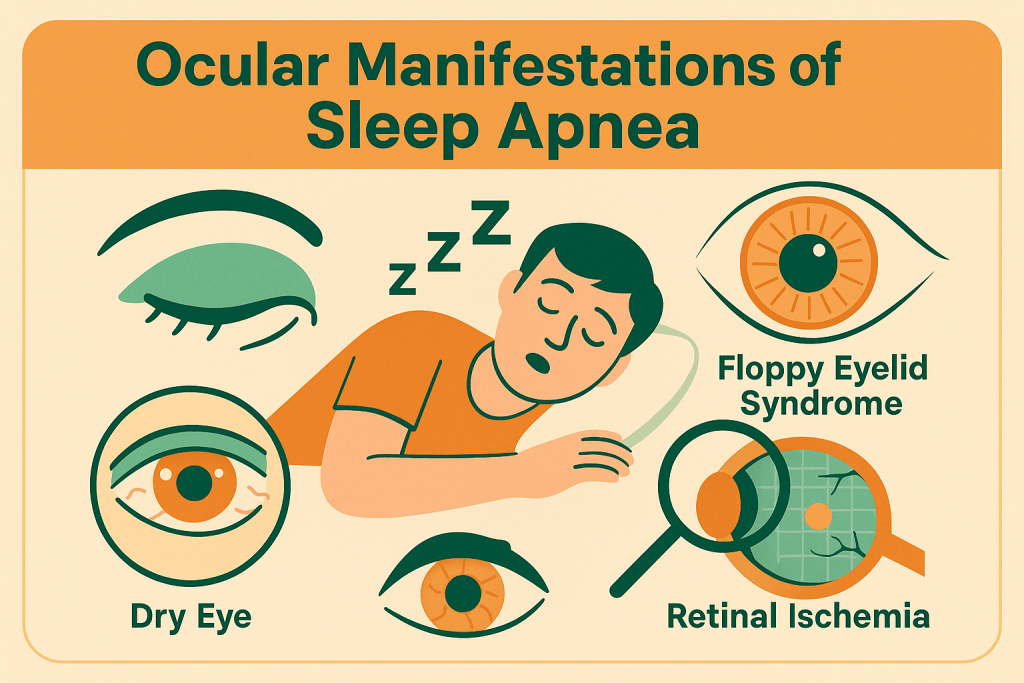
Ocular Manifestations of sleep apnea
Ocular surface and sleep fragmentation !
The ocular manifestations of sleep apnea reflect these underlying processes. One of the most frequent associations is ocular surface disease. Patients with moderate or severe Obstructive sleep apnea commonly exhibit reduced Schirmer scores, increased tear osmolarity, and meibomian gland dysfunction. Contributing factors include mouth breathing, nocturnal lagophthalmos, and low-grade systemic inflammation. Interestingly, continuous positive airway pressure (CPAP) therapy can either improve or worsen symptoms depending on mask fit. When mask leak is controlled, CPAP improves lacrimal gland function and increases tear stability after several months of therapy.
Glaucoma and Nocturnal intermittent hypoxia !
Obstructive sleep apnea also has a significant relationship with glaucomatous neurodegeneration. Epidemiologic studies consistently show that patients with Obstructive sleep apnea—especially severe untreated disease—have a higher risk of developing normal-tension glaucoma. Optical coherence tomography (OCT) and OCT-angiography have demonstrated thinning of the retinal nerve fiber layer (RNFL), reduction of ganglion cell layer (GCL) thickness, and decreased macular vessel density in untreated Obstructive sleep apnea patients. These changes correlate strongly with the severity of nocturnal hypoxia. Importantly, several longitudinal studies indicate that effective CPAP therapy leads to stabilization, and in some cases partial improvement, of GCL thickness and peripapillary perfusion, suggesting a neuroprotective benefit.
Vascular events and Obstructive Sleep apnea
Obstructive sleep apnea is also recognized as a powerful risk factor for non-arteritic anterior ischemic optic neuropathy (NAION). The combination of nocturnal hypotension, impaired optic nerve autoregulation, and oxygen desaturation increases the likelihood of ischemic events, particularly in individuals with “disc at risk” anatomy. Patients with untreated Obstructive sleep apnea are more likely to experience bilateral or sequential NAION. However, CPAP use has been associated with reduced incidence of fellow-eye involvement. Retinal vascular disorders—including central retinal vein occlusion (CRVO) and central retinal artery occlusion (CRAO)—also occur more frequently in OSA due to venous hypertension, endothelial dysfunction, platelet activation, and embolic tendencies.
Worsening of diabetic retinopathy with the presence of Obstructive sleep apnea
In diabetic patients, Obstructive sleep apnea enhances the progression of diabetic retinopathy by amplifying VEGF expression. This will worsen glycemic control, and promote chronic inflammation. Severe Obstructive sleep apnea is associated with higher rates of diabetic macular edema and poorer response to anti-VEGF therapy. Conversely, CPAP therapy can improve HbA1c levels, stabilize retinal perfusion, and reduce microaneurysm turnover.
Central serous chorioretinopathy with sleep fragmentation
Central serous chorioretinopathy (CSC) represents another notable association. The sympathetic over-drive and cortisol dysregulation characteristic of Obstructive sleep apnea create a physiological environment similar to chronic stress, promoting choroidal hyperpermeability and subretinal fluid accumulation. Patients with recurrent or bilateral CSC should be screened for sleep-disordered breathing.
Screening patients for Obstructive sleep apnea
Beyond ocular disease, Obstructive sleep apnea contributes to a number of systemic symptoms relevant to patient care, including morning headaches, gastroesophageal reflux, depression, anxiety, migraine, and even musculoskeletal problems such as trigger finger—many of which improve with CPAP therapy.
Finally, adherence to CPAP remains one of the most important determinants of clinical outcomes. Proper mask fitting, heated humidification, stepwise acclimatization, treatment of nasal obstruction, and early follow-up significantly improve long-term use. For clinicians—including ophthalmologists—understanding the systemic and ocular consequences of untreated Obstructive sleep apnea allows for earlier identification, timely referral, and more holistic patient care.
Q and A: Why the carotid is affected more with Atherosclerosis an interesting theory!
Recent research has highlighted an important mechanical mechanism linking snoring to vascular pathology—vibratory trauma to the carotid arterial endothelium. Loud, habitual snoring generates high-frequency oscillatory pressure waves within the upper airway that propagate to adjacent soft tissues, including the carotid bifurcation.
Experimental models and ultrasound-based vibration studies demonstrate that these oscillations can induce shear stress, microtrauma, and endothelial fatigue, particularly at points of natural turbulent flow such as the carotid bulb. Over time, this vibratory injury promotes endothelial dysfunction, impaired nitric oxide signaling, and increased local inflammation, creating a favorable environment for atherosclerotic plaque development and progression.
Some studies show that patients with severe snoring exhibit greater carotid intima–media thickness independent of traditional vascular risk factors, suggesting a direct biomechanical effect. This phenomenon helps explain why individuals with long-standing untreated OSA have higher rates of stroke and carotid atherosclerosis. In addition, why CPAP therapy—which eliminates apneic obstruction and significantly reduces snoring intensity—may confer vascular protection beyond improving oxygen saturation alone.