

Lecture performed by Dr. Deya Albtoush , Written By Prof. KHALIL ALSALEM
Why PENTACAM is important
Pentacam analysis has become an essential tool in modern keratoconus management, and in refractive surgery screening and the diagnosis of corneal ectatic disorders. Using a rotating Scheimpflug camera, the Pentacam provides a detailed three-dimensional analysis of the anterior segment, with particular accuracy in evaluating the cornea. In this article, we will explore how to systematically read Pentacam maps, understand key parameters, detect early keratoconus, and avoid common pitfalls in corneal topography. This guide is designed for ophthalmologists who want a structured, clinically relevant approach to Pentacam interpretation.
Download Dr. Deya albtoush lecture
How Pentacam Works
Scheimpflug Imaging Principle
The Pentacam uses a rotating Scheimpflug camera to capture multiple cross-sectional images of the anterior eye. These images are reconstructed into a three-dimensional corneal topography model, allowing precise measurement of corneal curvature, thickness, and elevation.
This technology provides dense data points, particularly in the central cornea, making it superior to traditional topography for detecting subtle abnormalities.
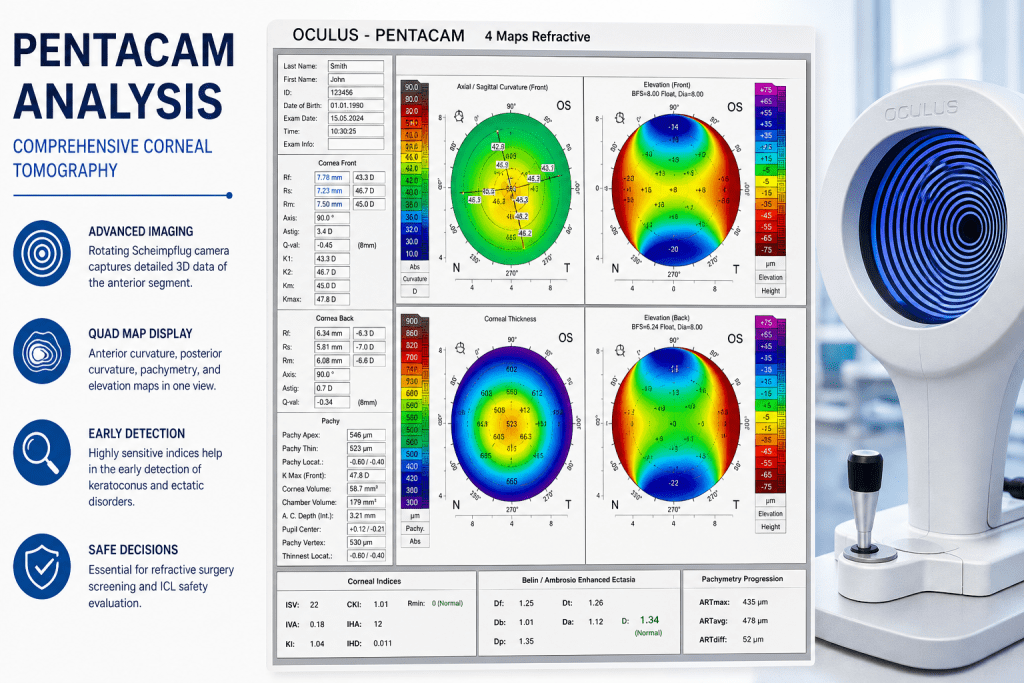
Understanding the Quad Map Display
The Quad Map is the core of Pentacam interpretation. It includes four essential maps: anterior curvature, posterior curvature, pachymetry, and elevation.
1. Quality Specification (QS)
Before interpreting any map, always check QS. A poor-quality scan due to blinking, tear film disturbance, or misalignment can lead to false conclusions.
Key Corneal Parameters in Pentacam
Keratometry Values of corneal topography
K1 represents the flat meridian, while K2 represents the steep meridian. The difference between them reflects corneal astigmatism. Normal values typically range around 43–44 diopters.
The mean keratometry (Km) is also important. Values below 40 D may indicate risk of flap complications, while values above 46 D may increase the risk of buttonhole formation in refractive surgery.
Kmax
Kmax represents the steepest point on the cornea. It is one of the most sensitive indicators for keratoconus. Values above 49 D are considered abnormal, and inter-eye differences greater than 2 D raise suspicion.
Q-Value (Asphericity)
The Q-value describes corneal shape. Normal corneas are slightly prolate, with values between -1 and 0. Positive values indicate oblate corneas, commonly seen after myopic LASIK.
Anterior Sagittal Curvature Map
Normal Patterns
The normal cornea typically shows a symmetric bow-tie pattern, representing regular astigmatism. Inferior-superior (I-S) difference should be less than 1.5 D.
Abnormal Patterns
Abnormal findings include skewed radial axes, asymmetric bow-tie, and irregular patterns. These may indicate early keratoconus or pellucid marginal degeneration.
Patterns such as “butterfly” or “claw” are classic for PMD, while significant asymmetry suggests corneal instability.
Elevation Maps: The Most Sensitive Indicator
Concept of Elevation
Elevation maps compare the cornea to a reference surface such as the Best Fit Sphere (BFS). Areas above the reference are shown as positive elevations, while depressions appear negative.
Normal vs Abnormal Patterns
A normal elevation map shows a symmetric hourglass pattern. Abnormal patterns include skewed hourglass, isolated islands, or tongue-like extensions, all suggesting corneal distortion.
Posterior elevation is particularly important, as early keratoconus often starts posteriorly before anterior changes become evident.
Pachymetry Map Interpretation in Pentacam
Normal Thickness Distribution
A normal cornea shows a concentric thickness pattern, with gradual increase from the center to the periphery.
Thinnest Location (TL)
The thinnest point is a critical parameter. Values below 470 µm are highly suspicious. The difference between the apex and thinnest location should be less than 10 µm.
Inferior displacement of the thinnest point is a key sign of keratoconus.
Abnormal Patterns in PENTACAM
Horizontal or vertical displacement suggests ectasia. Bell-shaped patterns are typical for PMD, while generalized thinning indicates keratoglobus.
Pentacam Indices for Keratoconus Detection
Surface and Symmetry Indices
Indices such as ISV and IVA measure corneal irregularity and asymmetry. IVA values above 0.28 are abnormal, and values above 0.32 are pathological.
Keratoconus Indices
KI and CKI compare curvature between different corneal zones. Elevated values suggest ectatic disease.
Pentacam Height and Decentration Indices
IHA and IHD measure elevation asymmetry and decentration. These are highly sensitive for early keratoconus detection.
Belin-Ambrosio Display (BAD): The Gold Standard
What BAD Represents
The BAD display integrates anterior elevation, posterior elevation, and pachymetry into a single analysis. It provides a comprehensive overview of corneal shape and is considered a quick screening tool.
Key Parameters
BAD includes multiple deviation indices such as Df, Db, Dp, Dt, and Da. These represent deviations from the normal database.
The final D value combines all parameters. Values above 2.6 standard deviations are highly suggestive of keratoconus.
Clinical Importance
Even if individual parameters appear normal, an abnormal final D should raise concern. This highlights the importance of integrated analysis rather than relying on a single parameter.
Pachymetric Progression and ART
Thickness Progression
The corneal thickness spatial profile (CTSP) evaluates how thickness increases from the thinnest point to the periphery. A steep slope indicates early keratoconus.
Ambrosio Relational Thickness (ART)
ART combines thickness and progression data. Values below 412 µm are strongly associated with keratoconus.
13-Point System for Systematic Reading
A structured approach is essential for reliable interpretation. The 13-point system includes evaluation of QS, Kmax, pachymetry, Q-value, curvature maps, elevation maps, and inter-eye comparison.
This method ensures that no critical parameter is missed and improves diagnostic accuracy.
Red Flags for Corneal Ectasia critical corneal topography signs
Several warning signs should immediately raise suspicion:
A difference greater than 30 µm between superior and inferior corneal thickness is abnormal. Similarly, inter-eye thickness differences above 30 µm are concerning.
Posterior elevation above 15 µm or anterior elevation above 12 µm is highly suggestive of ectasia.
Kmax values above 47 D and inter-eye differences above 2 D are also important indicators.
Early Keratoconus and Progressive corneal topography signs
Early keratoconus may present with subtle findings such as mild asymmetry or posterior elevation changes. Detecting these early changes is critical before refractive surgery.
Progression is defined by an increase in Kmax by at least 1 D, an increase in astigmatism, or a reduction in corneal thickness over time.
Clinical Applications of Pentacam
Refractive Surgery Screening
Pentacam is essential in identifying patients at risk of post-LASIK ectasia. Parameters such as Kmax, pachymetry, and BAD-D guide surgical decisions.
ICL Safety Evaluation
Safe implantation requires anterior chamber depth greater than 3 mm, angle above 30 degrees, and adequate chamber volume.
Diagnostic tools in Pentacam to detect Ectatic Disorders
Pentacam plays a key role in diagnosing keratoconus, pellucid marginal degeneration, and keratoglobus. Each condition has characteristic patterns on curvature, elevation, and pachymetry maps.
Common Pitfalls and False Findings in Pentacam
Pentacam interpretation can be affected by several factors. Contact lens wear, tear film instability, and misalignment can lead to false abnormalities.
Other factors include large angle kappa, corneal opacities, and previous surgeries. Always correlate findings clinically before making decisions.
Inter-Eye Asymmetry: A Key Diagnostic Tool
Comparing both eyes is crucial. Differences in keratometry, pachymetry, or elevation can indicate early disease even if each eye appears normal individually.
Significant asymmetry should always prompt further evaluation.
Conclusion
Pentacam analysis is a powerful tool that has transformed corneal diagnostics. However, its true value lies in systematic interpretation rather than isolated parameter analysis.
By integrating curvature, elevation, pachymetry, and indices, ophthalmologists can detect early keratoconus, prevent refractive surgery complications, and provide safer patient care.
A structured approach, such as the 13-point system, combined with awareness of red flags and pitfalls, ensures accurate and clinically meaningful interpretation.


