

Written by Prof. Khalil Alsalem , Lecture given by Dr. Husam ABU farsakh
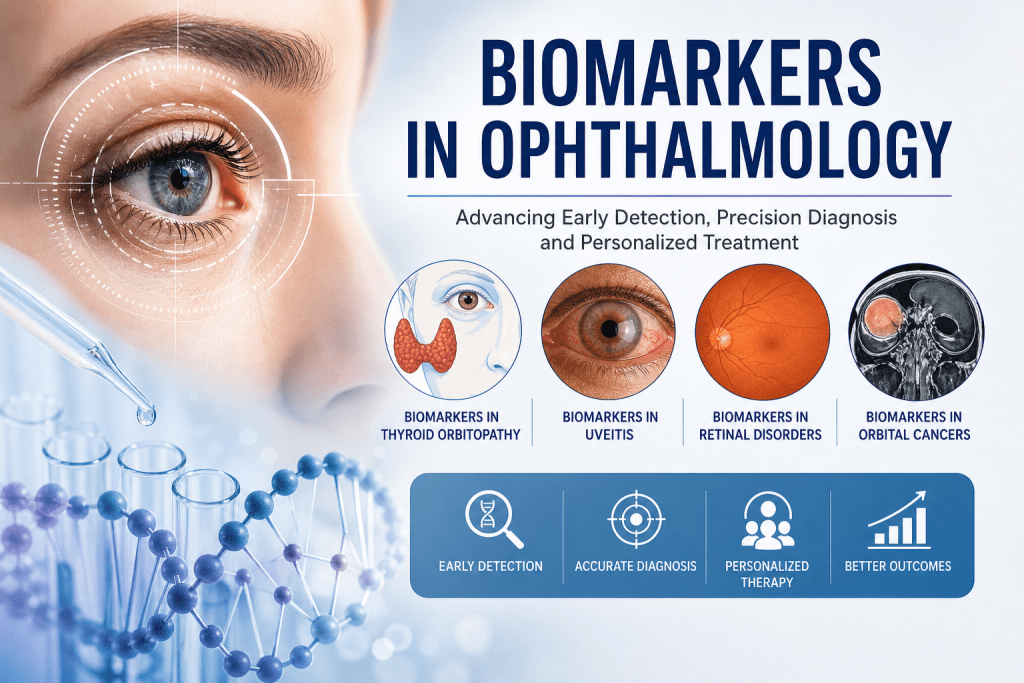
Biomarkers in ophthalmology are transforming how clinicians diagnose and monitor eye diseases. In recent years, the use of biomarkers in ophthalmology, including biomarkers in orbital cancers, biomarkers in uveitis, and biomarkers in thyroid orbitopathy, has gained remarkable attention. These measurable biological indicators allow earlier detection, more accurate disease classification, and improved treatment targeting. This article explores how biomarkers are reshaping clinical practice across retinal diseases, inflammatory conditions, and orbital pathology, while highlighting their growing importance in modern ophthalmology.
What Are Biomarkers in Ophthalmology?
Biomarkers are measurable biological signals that reflect physiological or pathological processes. In ophthalmology, they can be detected in blood, aqueous humor, vitreous fluid, or even through imaging techniques. These markers provide objective data that complements clinical examination.
Although traditional diagnosis relied heavily on clinical signs, biomarkers now offer deeper insight into disease mechanisms. For instance, inflammatory cytokines, autoantibodies, and genetic markers can reveal disease activity before structural damage becomes visible. As a result, clinicians can intervene earlier and tailor treatment more precisely.
Biomarkers in Thyroid Orbitopathy
Understanding the Role of Autoantibodies
Biomarkers in thyroid orbitopathy have significantly improved our understanding of disease pathogenesis. The condition, commonly associated with Graves’ disease, is driven by autoimmune mechanisms. The most important biomarkers include thyroid-stimulating hormone receptor antibodies (TSHR-Ab) and insulin-like growth factor-1 receptor (IGF-1R) antibodies.
These autoantibodies stimulate orbital fibroblasts, leading to inflammation, adipogenesis, and tissue expansion. Consequently, patients develop proptosis, diplopia, and, in severe cases, optic neuropathy.
Clinical Applications
TSHR antibody levels correlate with disease activity and severity. Therefore, they are useful not only for diagnosis but also for monitoring response to therapy. In addition, elevated IGF-1R signaling has opened the door for targeted therapies such as teprotumumab.
Interestingly, biomarkers can also help differentiate active inflammatory disease from fibrotic inactive stages. This distinction is critical, as immunosuppressive therapy is more effective during the active phase.
Biomarkers in Uveitis
Inflammatory and Immune Markers
Biomarkers in uveitis play a central role in identifying underlying etiologies. Uveitis is a heterogeneous group of diseases, often associated with systemic conditions such as sarcoidosis, Behçet disease, and infectious causes.
Key biomarkers include cytokines such as interleukin-6 (IL-6), interleukin-10 (IL-10), and tumor necrosis factor-alpha (TNF-α). Elevated IL-10 levels, for example, are particularly suggestive of intraocular lymphoma rather than benign inflammatory uveitis.
Diagnostic and Prognostic Value
The ratio of IL-10 to IL-6 in aqueous or vitreous samples can help distinguish between inflammatory and neoplastic processes. This is especially useful in challenging cases where clinical findings overlap.
Moreover, biomarkers can guide treatment decisions. Patients with high TNF-α levels may respond better to anti-TNF biologics. Therefore, biomarker profiling supports a personalized medicine approach in uveitis management.
Biomarkers in Retinal Disorders
Age-Related Macular Degeneration and Diabetic Retinopathy
Retinal diseases are among the leading causes of visual impairment worldwide. Biomarkers have become essential tools in detecting early disease and monitoring progression.
In age-related macular degeneration (AMD), complement system components such as C3 and C5 play a key role. Genetic polymorphisms in complement factor H are also strongly associated with disease risk.
In diabetic retinopathy, biomarkers such as vascular endothelial growth factor (VEGF), intercellular adhesion molecule-1 (ICAM-1), and inflammatory cytokines are elevated. These markers reflect vascular permeability, inflammation, and ischemia.
Imaging Biomarkers
In addition to molecular markers, imaging biomarkers are increasingly important. Optical coherence tomography (OCT) provides quantitative data such as retinal thickness, fluid accumulation, and hyperreflective foci.
These imaging features act as indirect biomarkers of disease activity. For example, subretinal fluid and intraretinal cysts indicate active disease requiring treatment.
Biomarkers in Orbital Cancers
Molecular and Genetic Indicators
Biomarkers in orbital cancers are critical for accurate diagnosis and treatment planning. Orbital tumors include a wide range of benign and malignant conditions, such as lymphoma, rhabdomyosarcoma, and metastatic lesions.
In orbital lymphoma, biomarkers such as CD20, BCL2, and Ki-67 are commonly used. These markers help classify the tumor subtype and predict aggressiveness.
Similarly, in rhabdomyosarcoma, genetic markers such as PAX3-FOXO1 fusion genes are associated with prognosis. Identifying these biomarkers allows clinicians to stratify patients and select appropriate therapy.
Role in Targeted Therapy
Biomarkers are also essential for guiding targeted treatments. For example, CD20 positivity in lymphoma supports the use of rituximab. This targeted approach improves outcomes while minimizing systemic toxicity.
Furthermore, advances in molecular diagnostics have enabled the detection of circulating tumor DNA. This non-invasive method holds promise for early diagnosis and monitoring recurrence.
Emerging Technologies and Future Directions
Liquid Biopsy in Ophthalmology
Liquid biopsy is an emerging technique that analyzes biomarkers in blood or ocular fluids. It offers a minimally invasive alternative to tissue biopsy, particularly in delicate structures such as the eye.
Although still in development, this approach may revolutionize the diagnosis of intraocular tumors and inflammatory diseases.
Artificial Intelligence and Biomarker Integration
Artificial intelligence (AI) is increasingly being integrated with biomarker research. Machine learning algorithms can analyze large datasets, combining clinical, imaging, and molecular information.
As a result, AI can identify patterns that are not visible to the human eye. This integration enhances diagnostic accuracy and supports decision-making in complex cases.
Clinical Impact of Biomarkers in Ophthalmology
The integration of biomarkers in ophthalmology has led to a paradigm shift in clinical practice. Instead of relying solely on clinical signs, clinicians now use objective data to guide diagnosis and treatment.
This approach improves patient outcomes in several ways. First, it allows earlier detection of disease. Second, it enables personalized treatment strategies. Third, it provides a reliable method for monitoring disease progression and response to therapy.
However, challenges remain. Standardization of biomarker testing and cost considerations must be addressed. Despite these limitations, the future of biomarker-driven ophthalmology is promising.
Conclusion
Biomarkers are redefining the landscape of ophthalmology. From biomarkers in thyroid orbitopathy to biomarkers in uveitis, retinal diseases, and biomarkers in orbital cancers, their role continues to expand. These tools offer deeper insight into disease mechanisms, enabling earlier diagnosis and more targeted treatment.
As technology advances, the integration of molecular, imaging, and AI-driven biomarkers will further enhance precision medicine in ophthalmology. Therefore, understanding and utilizing these biomarkers is essential for modern ophthalmic practice.
عمليات شد الجفون الجفون العيا و الفلى ، المنشور يوضح سبب الإنتفاخ ، علاجه و أخر المستجدات ، كن مع الأفضل في شد الأجفان د. خليل السالم